A broad brief and a real accessibility gap.
Discovery Cube's goal was ambitious but undefined: improve accessibility across the museum. They recognized that some visitors, particularly those from neurodiverse backgrounds, weren't feeling the museum was designed for them, leading to disengagement or avoidance altogether.
The client had one hard constraint: the solution needed to be physical, something visible and usable in the museum space itself. That meant we first had to identify where accessibility was actually breaking down before designing anything. The problem space was ours to define.
We intentionally designed for neurodivergent children and their caregivers. If an exhibit is understandable for kids more likely to face sensory, attention, or processing barriers, it becomes more intuitive for every visitor.
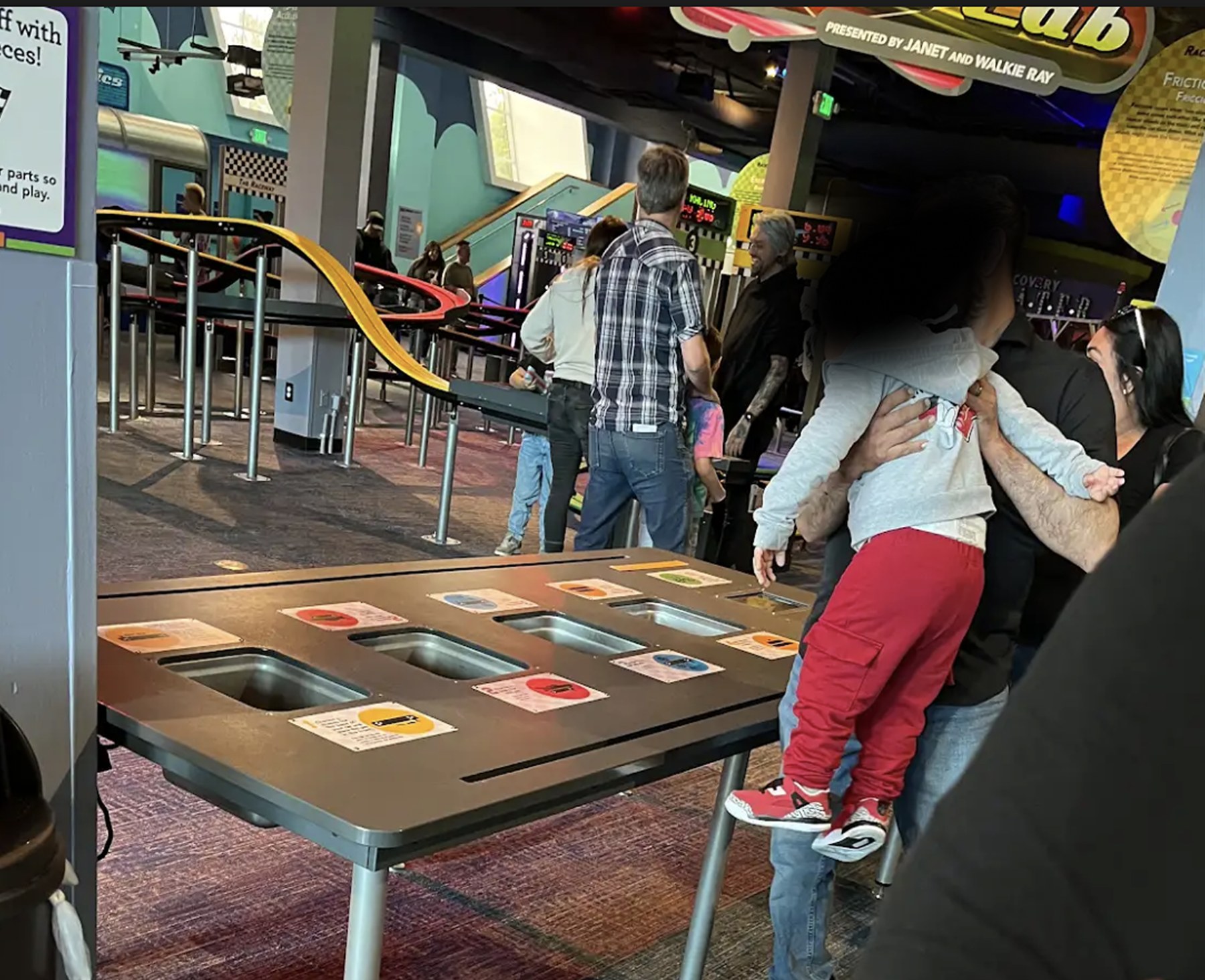
Field observation at Discovery Cube, tracking how caregivers and children navigate exhibit interactions together.
Four methods. One clear direction.
We combined four complementary methods to build a grounded picture of the problem, each one answering a different question about where and why accessibility was breaking down.
I led the visitor survey, reaching 119 Discovery Cube visitors. To standardize how we measured accessibility perception, I adapted the System Usability Scale (SUS) for a museum context, reframing questions around clarity, navigation, support, and inclusivity. This gave us a quantitative baseline to anchor our qualitative insights against.
We then interviewed 8 caregivers of neurodivergent children and 2 Discovery Cube staff members. Caregiver interviews helped us understand the routines, stressors, and support strategies families already rely on. Staff interviews let us validate what we were hearing and identify constraints we had to design within.
Finally, we conducted structured observations across four exhibit stations, tracking visitor behavior over 20-minute sessions at each. We recorded signage use, caregiver involvement, and accessibility barriers from our audit framework.
On paper, the museum looked fine: children without accessibility needs rated exhibits "Good." But nearly a quarter of the families we reached reported accessibility needs, and the aggregate score was hiding their experience. The barriers showed up in observation, not perception.
Narrowing to where we could have the most impact.
With research complete, we needed to commit to a specific problem. The data pointed clearly toward signage as the highest-leverage intervention: unclear instructions were the most consistent source of confusion across every exhibit we observed. Unlike hardware changes, signage was something we could design, test, and hand off within our timeline.
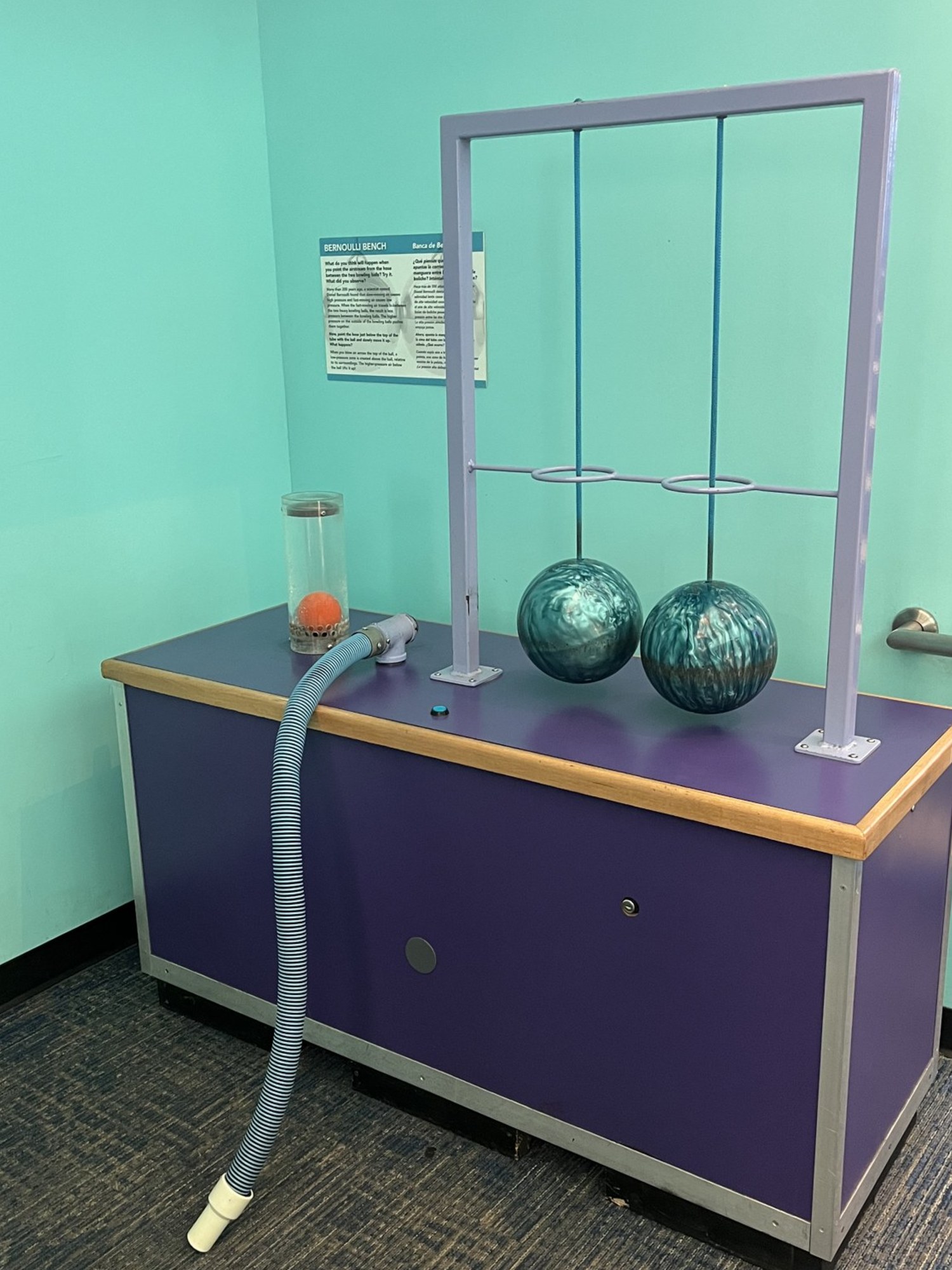
We then selected Bernoulli Bench as our pilot. Out of the four stations we observed, it generated the most confusion about both the exhibit goal and the next steps, making it the strongest candidate for a meaningful before-and-after comparison.
The intent was never to solve one exhibit in isolation. The goal was to establish a repeatable signage approach Discovery Cube could apply museum-wide, a model that could scale without requiring a full redesign at every station.
Bernoulli Bench wasn't chosen because it was the worst. It was chosen because it was the most representative. Solving it well would create a template for the rest of the museum.
Designing with the people who would use it.
Before making any design decisions, we ran a co-design workshop with neurodivergent children and their caregivers. The goal was to involve the people we were designing for, not just observe them or make assumptions on their behalf.
Participants consistently emphasized the need for instructions that are quick to scan, visual-first, and focused on the immediate next step, not a full list of everything the exhibit does. Caregivers named a specific pain point: effective signage should reduce how often they need to step in and translate directions in a busy, distracting environment.
The workshop also taught us to hold our plans loosely. Some participants struggled with our structured activities, so we pivoted to free exploration and observation. That shift still produced strong, natural insights, and reminded us that research plans should serve the participant, not the researcher.
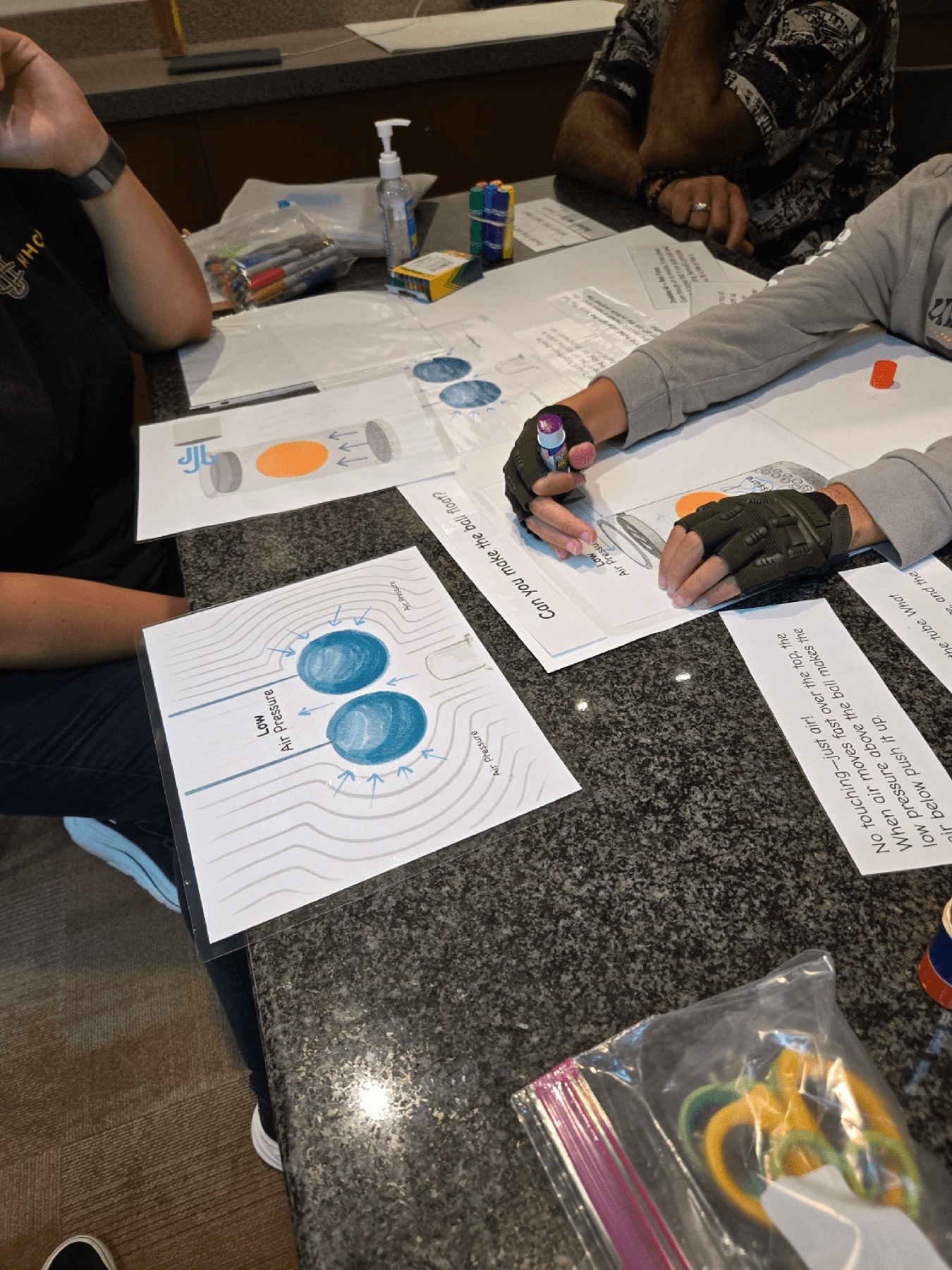
Co-design workshop with neurodivergent children and caregivers, generating signage ideas together.
Six principles. One exhibit. A model for the rest.
From the workshop, we defined six design principles to keep decisions consistent across every iteration. Every choice, including placement, language, and visual hierarchy, was evaluated against this framework.
Each principle traces directly back to a research finding or a moment from the co-design workshop, so when we debated a layout or a phrasing, the question was never "what looks better?" but "which option serves the principle?"
Make the next step obvious
Visitors should immediately understand what to do first, then what to do next, without needing to read a full paragraph.
From: "Confusion leads to disengagement"Visual-first guidance
Use diagrams and short action phrases so instructions work for non-readers and early readers alike.
From: "Visitors learn best through visuals"Reduce cognitive load
Keep language short, remove unnecessary detail, and avoid overwhelming visitors with too much at once.
From: "Neurodivergent families face compounded barriers"Support caregivers without depending on them
The exhibit should be usable independently, while still easy for a caregiver to quickly understand and explain if needed.
From: "Adults become the support system"Clarify what success looks like
Provide a clear cue for what visitors are trying to achieve so they can self-correct without guessing or giving up.
From: co-design workshop feedbackFit the real museum context
Instructions must be easy to notice, durable, and effective in a noisy, high-distraction environment.
From: staff interviews & floor observations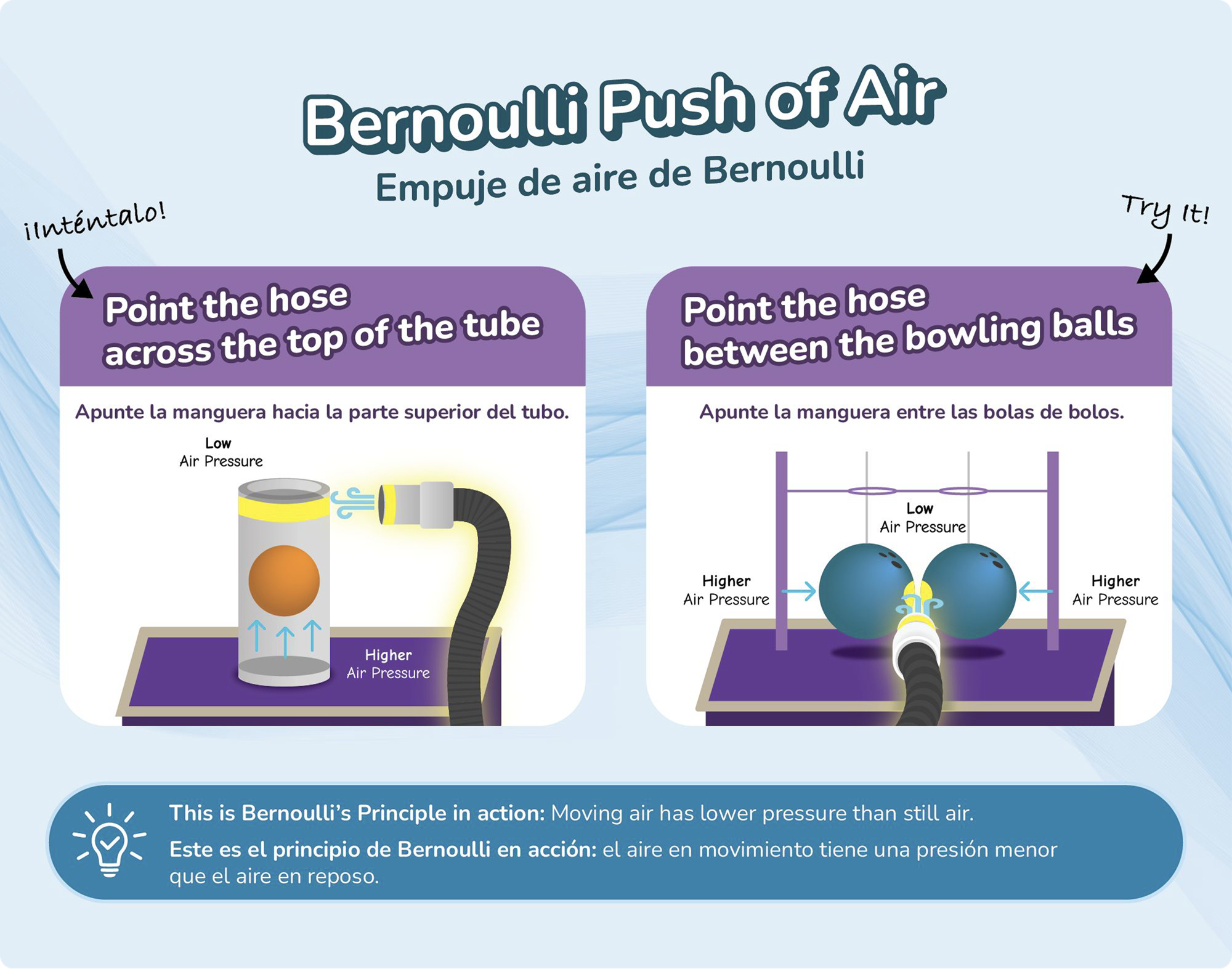
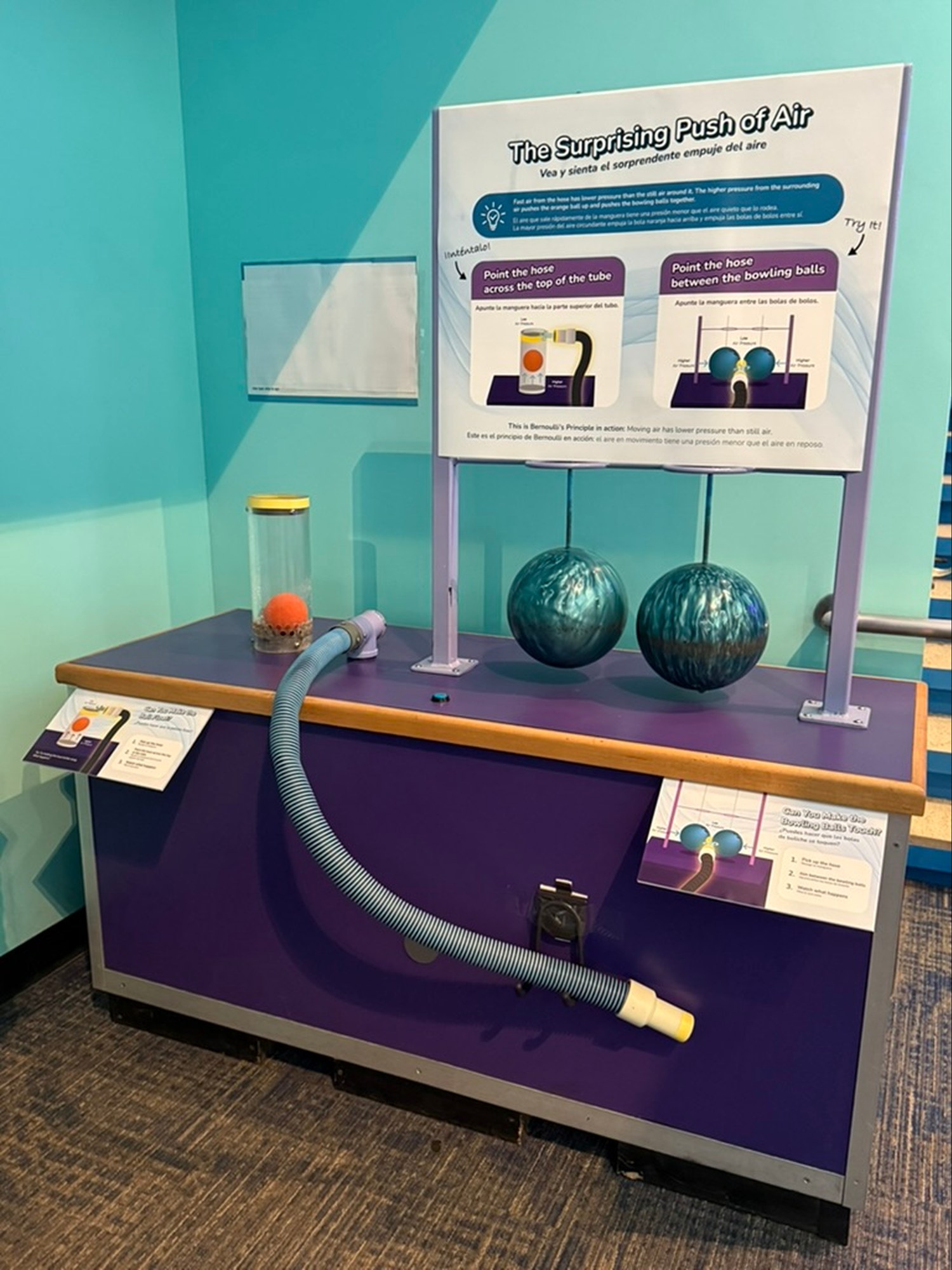
Concept in the title
"Bernoulli Push of Air" names the science idea up front, giving the exhibit an identity, not just instructions.
Clear action first
Each panel leads with a single instruction, like "Point the hose…," so the next step is never in question.
Experiment first
"¡Inténtalo!" / "Try it!" invites doing before explaining. Curiosity leads, theory follows.
Visual over text
Diagrams carry the instruction; words support. The sign works for non-readers and early readers alike.
Feedback & completion
Each step shows what success looks like, so visitors can self-correct without giving up.
Accessible placement
Signs sit at the point of interaction, at children's eye level, so guidance lives where the action happens.
Shared engagement
A bilingual "this is Bernoulli's Principle in action" footer gives caregivers a script to share the why.
The final signage system for Bernoulli Bench, where every design move above traces back to one of the six principles.
Instead of one central instruction panel, we broke guidance into smaller signs placed at each interaction point. That way, the instruction lives exactly where the action happens, so no visitor has to hold multiple steps in memory while navigating a noisy museum floor.
Validating on the museum floor.
We tested our prototype in the live museum environment, comparing visitor behavior with the existing signage against our redesign. We ran two structured tasks at Bernoulli Bench: a tube task, where visitors directed airflow through a series of tubes, and a bowling ball task, where visitors used a blower to lift and balance a ball. Both required understanding the exhibit goal and following multi-step, spatial instructions in a busy, unpredictable space.
The baseline made the problem concrete: with the existing signage, only about 1 in 5 visitors completed the tube task. That number became our benchmark: the thing the redesign had to beat.
Each session was observed by a team member tracking whether visitors engaged independently, how quickly they understood what to do, and how often caregivers needed to step in. We followed each session with brief exit interviews to capture perceived clarity and confidence.
A measurable improvement and a scalable direction.
Testing confirmed a significant improvement in task success over the baseline, where only 20.4% of visitors had completed the tube task with the original signage. More visitors completed both tasks independently, and caregivers intervened far less frequently. The redesigned signage resolved the confusion that had been consistently breaking down the experience at this station.
Beyond the pilot, we delivered three final outputs: documented research insights, the redesigned signage system for Bernoulli Bench, and a set of museum-wide accessibility recommendations covering staff training, multi-modal information design, and family-unit accessibility.
Key guidance for scaling: prioritize visuals over text, design for different heights and abilities, highlight goals and success cues at every step, and maintain a consistent signage style across exhibits so visitors learn the pattern once and apply it everywhere they go.
What I took away.
This project reinforced that accessibility work starts with listening and stays grounded in real behavior. The most powerful insight was how small, practical changes in physical spaces, when based on people's actual experiences, can meaningfully reduce cognitive and emotional load for visitors who already carry more of it than most.
It also pushed me to think beyond a single interface and design for a hands-on experience where caregivers, siblings, and staff all shape whether a child can successfully engage. Accessibility in a museum isn't just about the exhibit. It's about the whole system around it.
The co-design session was the hardest part to navigate. Neurodivergence varied greatly across our group, and some participants struggled with the planned activities. Pivoting to free exploration was the right call, and the natural insights that came from it were some of the most useful in the entire project. It's a reminder to hold research plans loosely and follow what's actually happening.